


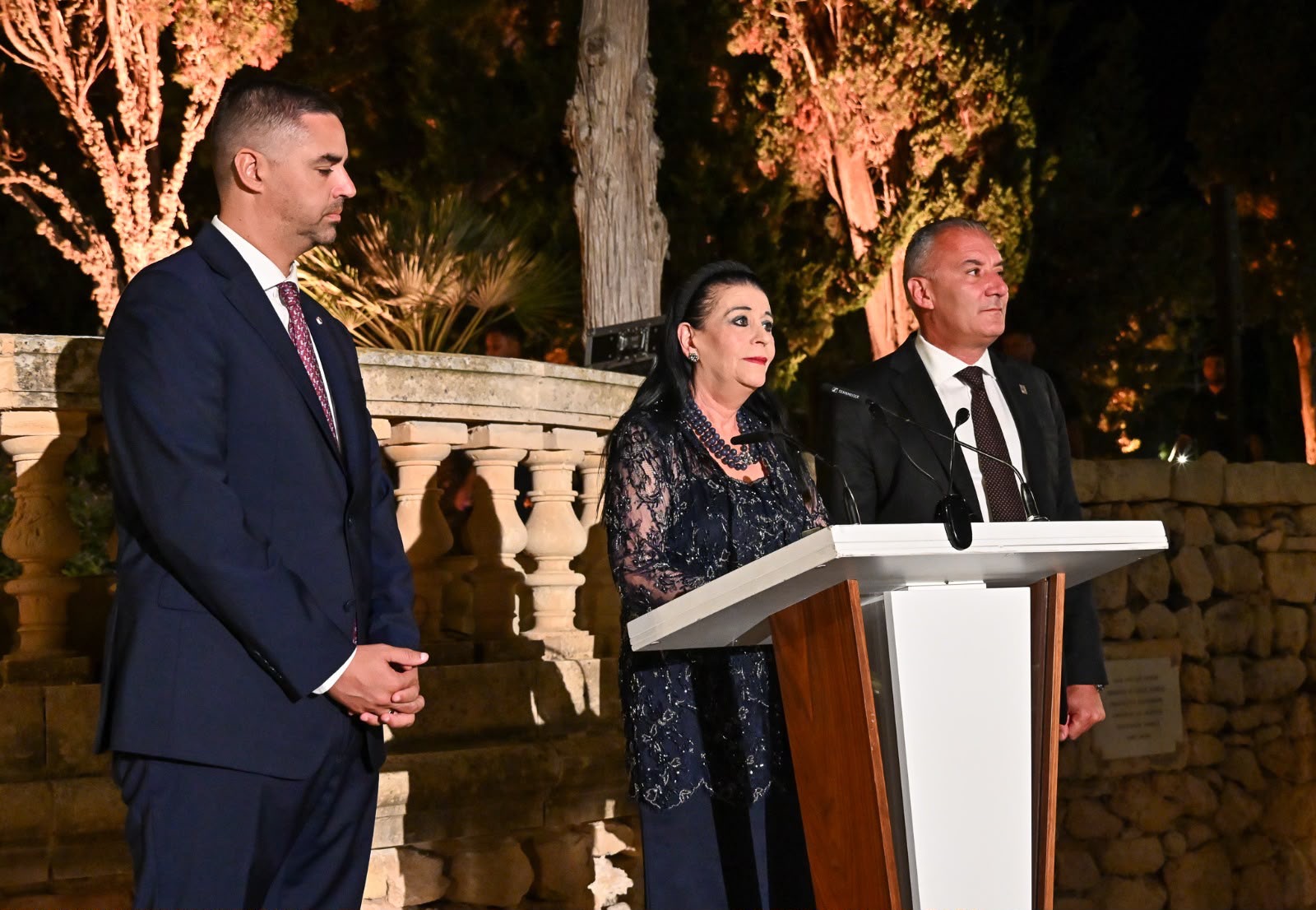
It is an honour for Malta to host the World Travel & Tourism Council and so many distinguished leaders from across the international travel and tourism community and it is with great pleasure that I welcome you all to Verdala Castle this evening.
The presence of all of you here representing the private and government sectors of travel & tourism, to map, and determine the direction which tourism and travel will take in the years to come, is important.
And it is particularly pertinent that these conversations/these discussions on the topic of tourism, its innovation and economic growth are being held here in Malta.
As an island nation, whose own culture and identity have been forged throughout its history by movements, exchanges and encounters among peoples, we view tourism as a bridge between peoples.
For centuries, our nation’s geographic location has been important, not just for the exchange of goods, but also for people-to-people relations, highlighting the openness of Malta to other people and cultures.
Today, this same openness remains one of our biggest assets.
Ladies and Gentlemen,
Travel and Tourism are far more than just an industry -They are direct contributors towards a country’s economy and a main source of generation of investment, producing countless opportunities of economic activities.
In Malta, we are particularly aware of this – not only its positive aspects, but we are also increasingly observant of any downsides which may emerge.
By June of this year, Malta recorded more than 2.1 million inbound tourists, an 18% increase on the corresponding period of 2025.
Along with this, tourist expenditure in the first six months approached a record €1.8billion.
A direct contribution of around 16.9% to Malta’s GDP is expected from the wider travel and tourism sector, worth noting is the fact that tourism supports more than 72,000 jobs in Malta and Gozo.
These figures impressively illustrate the potential that travel and tourism have when they are part of a nation’s economic structures. However, this is not a complete picture.
In fact, nowadays, we have to ask ourselves not how much more can tourism grow, but how can tourism grow better.
The subtle wording serves to put the focus on sustainability rather than quantity, the need to sensitise the sector in a way that it can cope with today’s challenges.
The concept of sustainability is of utmost importance and pushes us to set standards that protect what makes our countries worth visiting in the first place.
Tourism can never be sustainable if it jeopardizes the quality of life of the people who consider that particular corner of the globe, their home.
Many might misinterpret the concept of sustainability as a potential obstacle that hinders economic growth. However, sustainability ensures that economic growth can endure, and fosters a resilient economy capable of adapting to ecological limits, securing sustained well-being across social, environmental, and economic domains.
For Malta, and the rest of the world, this means gradually moving beyond an economic model driven predominantly by volume towards one based increasingly on value.
This can be achieved, by ensuring diversified experiences offered by destinations encouraging tourism across different communities and regions, whilst promoting collaboration between different niches – culture, gastronomy, hospitality, education and sport.
Malta has already implemented sustainability efforts by improving connectivity. In this way tourism has spread beyond the traditional peak summer periods, making Malta and Gozo an all-year destination, injecting more than EUR 456 million in the first half of 2026 alone.
However, higher value tourism should mean much more than just numbers.
Quality is also measured through the active and direct contribution that tourism leaves on our communities and the opportunities it can create for SMEs, whilst preserving the identity and authenticity of a destination.
This transition aims to propel the tourism industry forward, facilitating its evolution alongside advances in digitalisation, artificial intelligence, data, and green technologies.
The advanced digital era, which includes the infiltration of AI in day-to-day systems, can be used to understand visitor patterns more accurately, whilst it can manage congestion more effectively, thereby reducing the environmental footprint of accommodation and transport.
Ladies and Gentlemen,
Travel has always been about movement. The challenge before us now is to ensure that this movement continues to be equated with progress.
However, it is of paramount importance to continue being aware that despite advancements in technology, tourism remains profoundly human; no technology can replace the warmth of human interaction.
Tourism facilitates interaction between peoples, transcending political borders, breaking down barriers of prejudice.
The ambition of all of us here today should be, to confront the challenges the industry is currently facing, at the same time striving to bequeath the industry better and more solidly sustainable solutions for the greater good of future generations.
I wish you fruitful discussions aimed at shaping a resilient tourism industry for the future, as well as an enjoyable evening.
Thank you.