

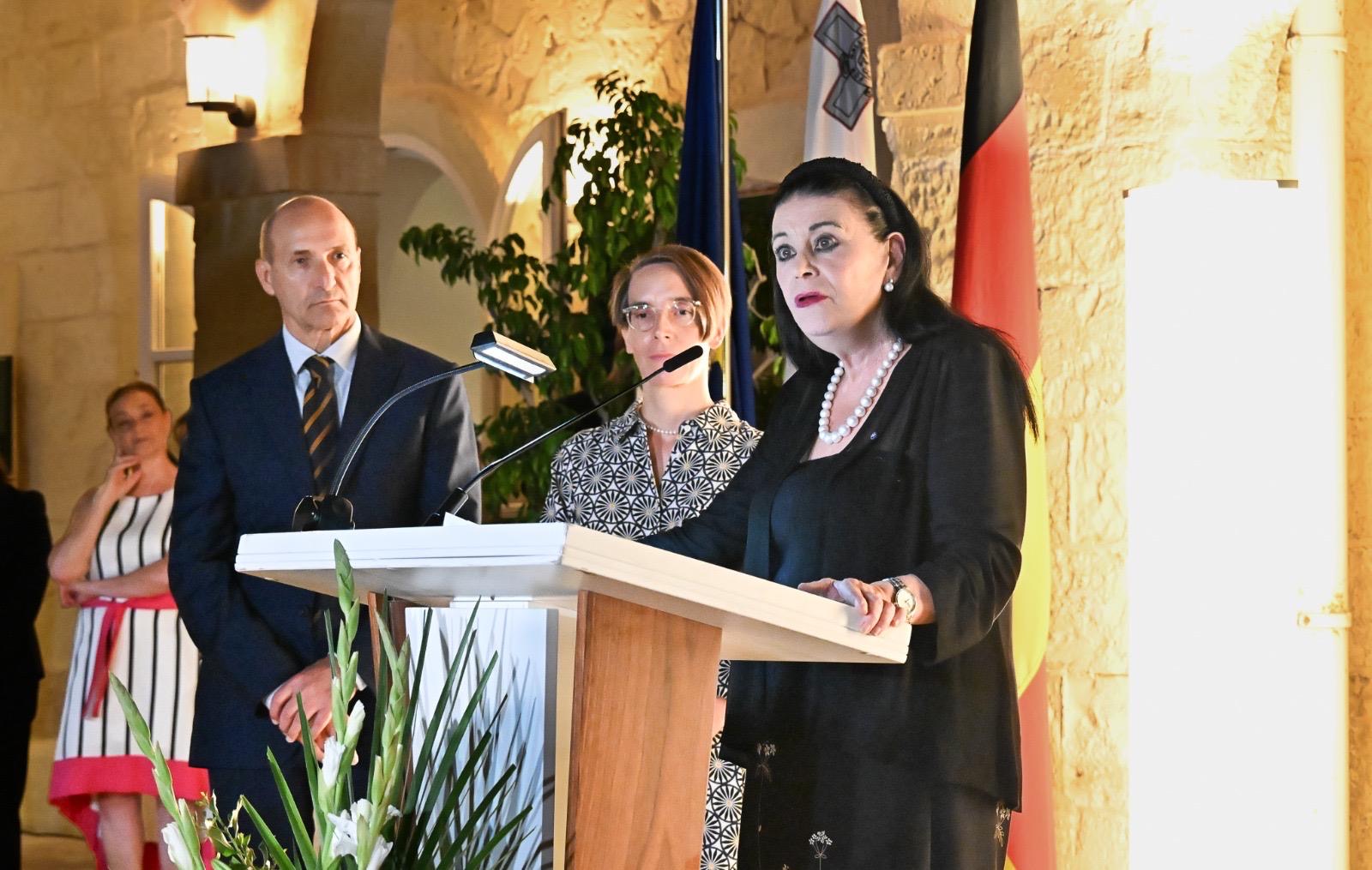
We gather here today to commemorate the National Day of the Federal Republic of Germany, marking the reunification of East and West Germany in 1990. This day holds a significant place in history, as it remodelled the shape of democracy in Europe.
This event also inspired millions around the world, sending a powerful message that war and division neednot be permanent, and that peace and unity can prevailwhen leaders demonstrate the political will to bring about meaningful change.
Tonight’s occasion is also an opportunity for us to celebrate the strong and lasting diplomatic ties between our countries, a bond built on the principles of respect, equality, and shared values.
Malta remains fully committed to building on the solid foundations laid 61 years ago when bilateral relations between our States were formally established. These ties have brought our nations and our peoples closer to each other, enabling exchanges and cooperation in many different sectors.
To this day, Germany remains one of Malta’s most important EU economic partners in both goods and services, as trade continues to flourish.
Investment is strong, with many German shareholdingcompanies operating in Malta across aviation, advanced manufacturing, and specialised industries.
Malta-linked companies operating in Germany are also increasingly active and diversified, with activities spanning iGaming, fintech, banking, payment services, investment, real estate, telecommunications, semiconductor technology, manufacturing, and corporate services.
Furthermore, in 2025-2026, Malta maintained an active commercial presence through participation in major fairs across Germany; this participation helps strengthen ties in a tangible and direct manner.
We also warmly welcome the boosting of trade cooperation with the Malta-Germany Business Council,and stronger working ties with German institutional entities.
All these developments are a clear illustration of the mature bilateral investment relationship between our two countries.
Looking ahead, there is still considerable scope to deepen and broaden cooperation in areas of shared strategic priority. These include digitalisation, the green transition, life sciences, and advanced manufacturing, all sectors where our economies possess complementary strengths and ambitions.
Malta will encourage and facilitate all measures that are aimed at promoting ties between our countries andincreased interaction between our respective commercial stakeholders.
I am also pleased to note the high level of cooperation that exists in the fields of education and culture, such as thenumerous agreements between the University of Malta and German universities, schools of applied sciences, research entities and networks. These are valuable partnerships, for they support research collaboration and the sharing of knowledge.
Furthermore, Malta remains deeply appreciative of the collaboration and financial support that the German Federal Foreign Office has been offering to theMediterranean Academy of Diplomatic Studies (MEDAC)since 2009. These contributions are crucial for MEDAC’s operations, and for this we are grateful.
Tourism is another vibrant pillar of our relationship, and a primary contributor to ensuring people-to-people contacts. Recent figures in this sector underscore thispositive momentum, with a significant number of German tourists visiting our shores, and a growing number ofMaltese choosing to spend their holidays in Germany.
Beyond trade and bilateral initiatives, our relationship isalso built on common European values: respect for human dignity, freedom, democracy, equality, the rule of law, and human rights.
These are reinforced by an unwavering commitment towards the UN Charter and international law, principles that both our countries consistently uphold and promotein international fora.
These are values which should be centre stage in the contemporary world, besieged by geopolitical tensions, conflicts, and cross-border issues which dominate headlines.
As European countries, Russia’s aggression against Ukraine has been a matter of great concern for both Malta and Germany. From the outset, both our countries have been unequivocal in condemning this war, which has caused immense suffering and loss of life among the Ukrainian people.
Attacks targeting civilians and civilian infrastructure, including the recent drone strike on a civilian train near the Ukraine-Poland border, are a stark reminder of the fear that the people of Ukraine have to contend with on a daily basis.
Such incidents also illustrate the impact that this conflict is having on European security. They emphasise the need for concerted efforts and solidarity to ensure that peace on the rest of the continent is preserved.
The situation in the Middle East remains a matter of profound international concern. The humanitarian situation in Gaza remains dire, with civilians lacking essential needs. To this extent, unhindered humanitarian access is essential in order to alleviate the suffering of the people in Gaza.
Malta is also deeply concerned about the situation in and around Iran, where military activities are leading to instability in the region.
We truly hope that all parties to this conflict uphold their legal and moral obligations, ensuring the protection of civilians and civilian infrastructure, while exercising maximum restraint to avoid actions that risk further human suffering and destabilisation.
Furthermore, developments affecting maritime security in and around the Strait of Hormuz and Bab el-Mandeb Strait remain deeply worrying.
Here too, it is critical that international maritime law is observed at all times, so that freedom of navigation can be ensured, and the impact on global trade is mitigated as much as possible.
Consistent and determined action is needed to make sure that international law, including international humanitarian law, is observed and respected at all times.
Safeguarding the rules-based framework, with the United Nations at its core, is key if we are to effectively address contemporary challenges, such as climate change and cyber security. These pressing issues can no longer be put on the backburner for future generations to deal with.
To this end, we need to invest in the current structures, both politically and financially, to make sure that they serve us well in the years to come.
Indeed, the ambition to leave the world a better place must remain the guiding principle of all our actions. We must strive to ensure that the world our children and grandchildren inherit is a more peaceful, more prosperous, and a kinder place than the one we ourselves inherited.
Ladies and gentlemen
I once again extend my thanks to Ambassador Beyer for hosting us this evening. I express my sincere appreciation for your dedication and contribution to strengthening the ties between our two nations.
Malta will keep the strengthening of relations with Germany among its foremost priorities in the years to come.
On behalf of the people of Malta, may I now invite you tojoin me in a toast to the continued well-being of His Excellency President Frank Walter Steinmeier, and to the enduring friendship between our nations and our peoples.