


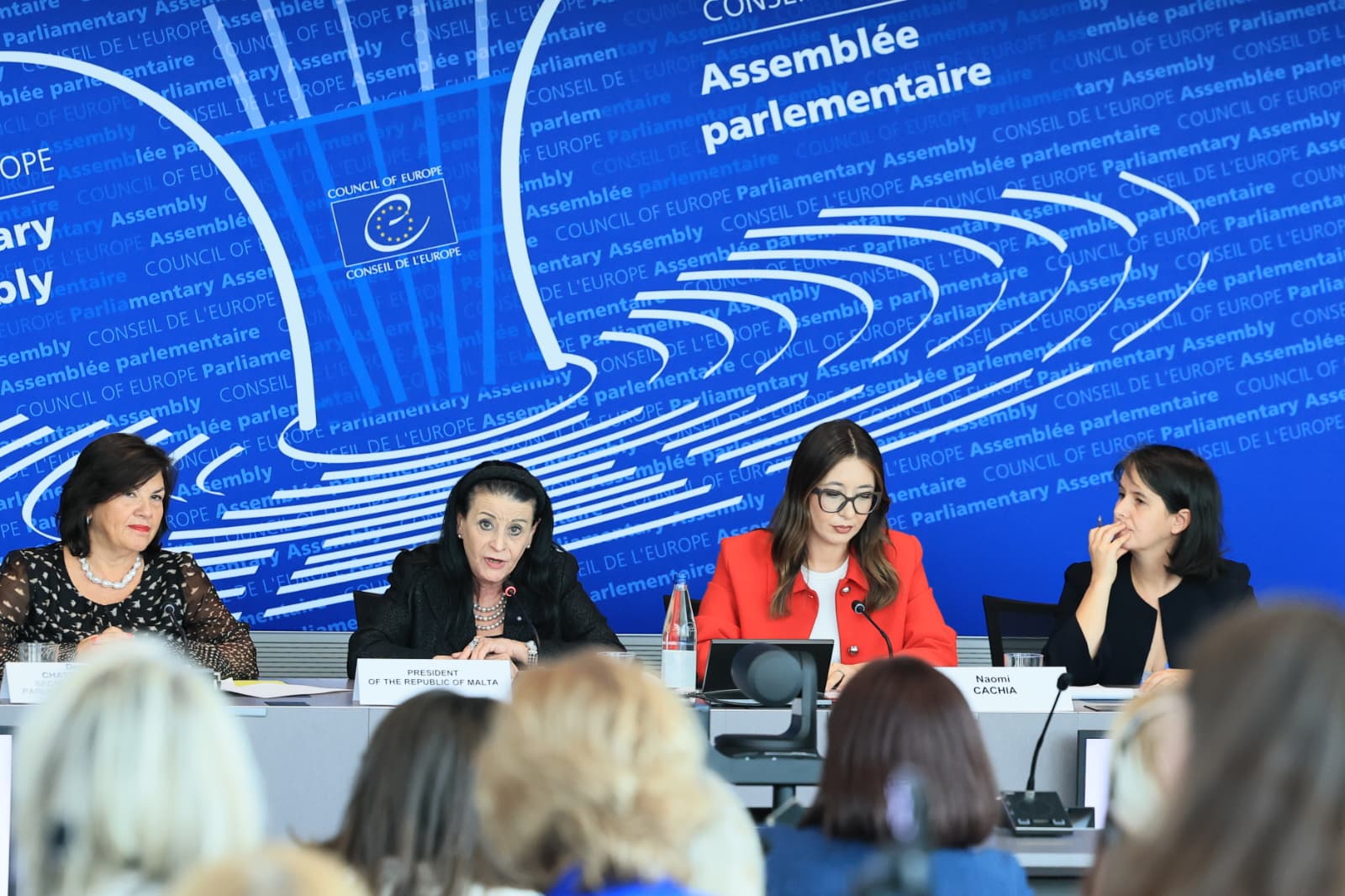
Secretary General of the Parliamentary Assembly,
Distinguished Members of the Parliamentary Assembly,
Excellencies,
Ladies
I am very happy to join you today at this important side event. I extend my warmest greetings to the Secretary General, ambassadors, distinguished representatives, and to all women members of PACE who form this dynamic and inspiring network.
We are gathered in a context that demands both reflection and action, coming together not just to discuss gender equality but to confront its unfinished journey.
This last century has witnessed the advent of women into the field of politics in a more visible manner.
Yet despite the remarkable progress that has been made in recent decades, women across our continent and across the world, continue to face structural barriers in leadership, politics, and in the workplace.
The gender gap and the underlying pressures placed upon women to balance careers and family responsibilities remain pressing challenges and persistent hurdles are preventing women from breaking the glass ceiling once and for all.
These are not perceived issues that are exaggerated or blown out of proportion. They are realities that I, and many of you, have been confronted with throughout our lives.
All my life, I have witnessed firsthand the subtle bias and overt sexist remarks that women continue to face.
Expectations about appearances, the underestimation of women’s abilities, the pigeon-holing of women’s capabilities; these are prejudices rooted in stereotypes. These are pressures that demand resilience to rise above.
Navigating leadership as a woman often requires proving yourself time and time again, balancing the demands of professional life with societal expectations, familial life, and advocating changes in attitudes and support systems not only for your generation but in most cases to forge a better way forward for our daughters and granddaughters.
Our political institutions are not immune to these challenges. The Parliamentary Assembly of the Council of Europe, through Resolution 2615(2021), highlights the importance of inclusive participation in parliamentary life. It calls for practical measures to achieve a balanced representation of women and men in national parliaments, striving towards parity.
This framework is essential, but policies alone are not enough.
We must create a culture where women – AND MEN – actively support one another, challenge unfair practices, and make leadership truly accessible to all, regardless of gender. Men have a key role as allies in breaking down barriers. Only by working together can we dismantle the structural inequalities that still exist and turn the promise of equality into reality.
This brings me to a second, deeply important theme: the power of cross-generational solidarity and mentorship.
Change does not occur in isolation. Our responsibility today is not only to claim space for ourselves but to ensure that the next generation of women is equipped to step into leadership roles. I cannot overstate the importance of mentoring young women and girls; sharing the lessons drawn from decades of struggling for equality.
We must instil in our young women the conviction that women deserve a place at the table, even the top table. The transformative power of mentorship, of women lifting each other up, cannot be underestimated. In this endeavour, we must harness the commitment of men who in most hierarchies of power still hold the majority.
Building confidence in girls from a young age is crucial. Confidence to speak up in the classroom, to participate in community life, to not only imagine but to see themselves as leaders.
These foundational moments lay the groundwork for a society in which equality is normalised, not exceptional. Leaders carry a joint responsibility: to create environments, both formal and informal, where female aspirations are supported, where opportunities for leadership roles side-by-side with men concretely exist.
Policies alone do not bring about miracles. Mentorship and cross-generational solidarity are intimately linked with breaking barriers in leadership. Policies must be backed by a culture of encouragement, guidance, and recognition. When women support women, when experience is shared freely, when networks are intentionally built, the invisible walls that limit progress begin to crumble. Furthermore, when this culture of support extends to men as allies, institutions themselves become stronger, more representative.
This is the basis of a cohesion that should exist not only between men and women; but also among all humankind.
I am often asked what sustains resilience over decades in public life.
My answer is simple: it is the knowledge that our efforts are not only for ourselves but for those who come after us. Every achievement is magnified when it serves as a beacon for younger women, inspiring them to aim higher and to claim spaces they were once denied.
As we discuss strategies, policies, and practical steps here today, let us bear in mind that our goal is not merely equality in numbers, but equality in opportunity, voice, and influence. Let us commit to fostering mentorship programs, cross-generational networks, and inclusive spaces that empower women from all backgrounds to thrive. Let us celebrate the achievements of women while remaining ever vigilant against complacency.
One of the Maltese Presidency policy priorities, namely ‘Combating Violence and Discrimination in all its forms while promoting Equality’, speaks directly to the very heart of our European project: dignity, equality, and the rule of law.
Gender equality is not a niche issue; it is central to the health and legitimacy of democracy itself.
When women participate equally in leadership and governance, policies reflect broader perspectives, institutions gain credibility, and societies become more resilient. And when young women see leaders and mentors who look like them, who talk like them, they recognise democracy as a system that should include them, inspiring them to pursue roles once considered out of reach, to excavate spaces for themselves.
I urge all of us here today to carry forward a commitment to lift each other, to share knowledge, and to break down barriers for those who follow. We have got to give new life to the concept of sisterhood in politics.
And please, do allow me to put in a word for the resurgence of sisterhood, not only in Europe, but across national borders and across continents.
I am truly grateful for the opportunity to be part of this exchange, and look forward to hearing your questions, thoughts, and experiences as we continue this important conversation together.