


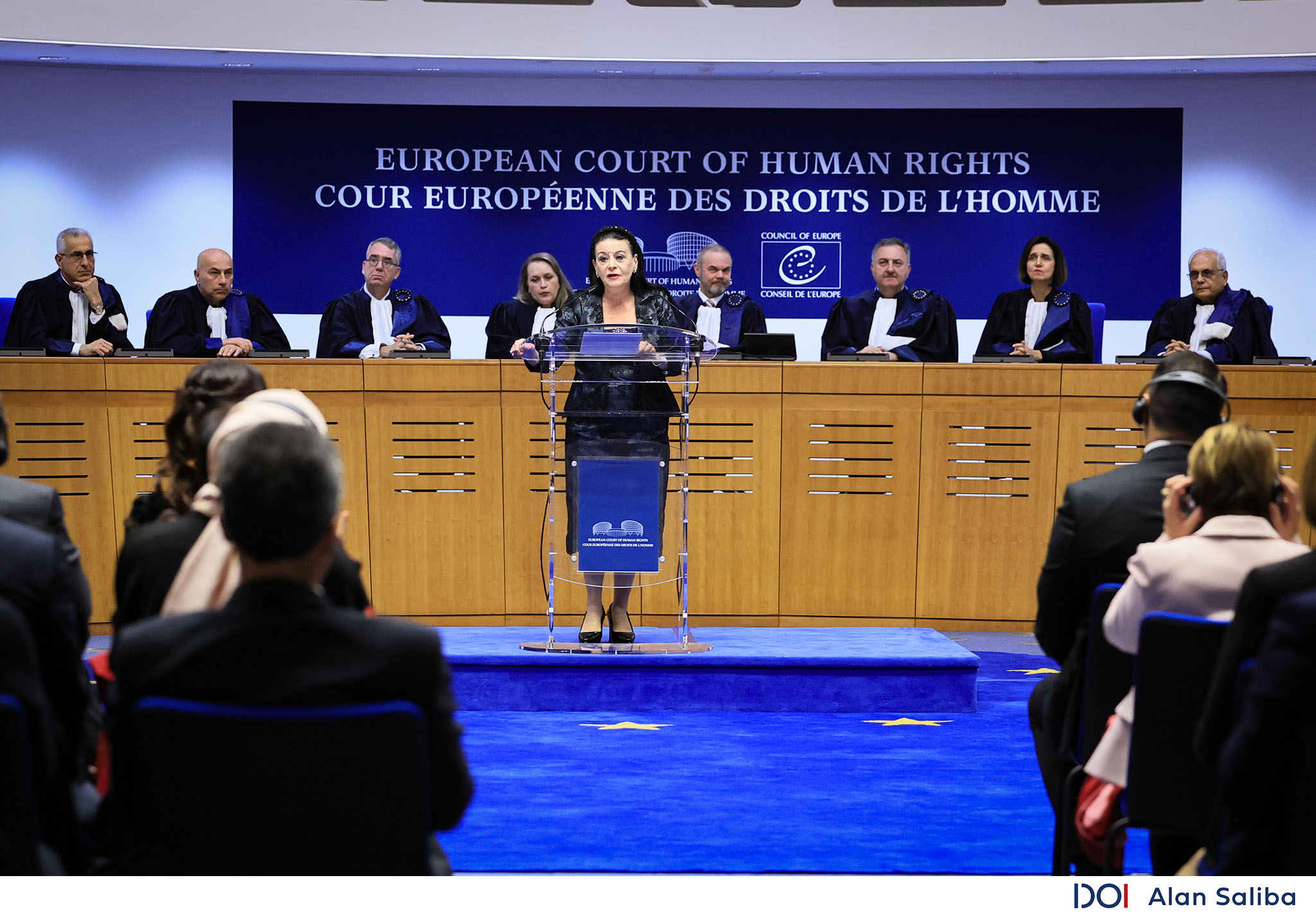
President of the European Court of Human Rights,
Secretary General of the Council of Europe,
President of the Parliamentary Assembly,
Honourable Judges,
Excellencies,
Distinguished Guests,
Seventy-five years ago, Europe made a promise forged in the raw memory of war, tyranny, and shattered lives.
It was a commitment born of urgency: to replace the rule of power with the rule of values; with Freedom, Justice and Human dignity as the foundations for lasting peace.
Adopted in 1950, in the aftermath of humanity’s darkest hours, the European Convention on Human Rights has since become a cornerstone of human rights protection, democratic stability and the rule of law across our continent.
For seventy-five years, it has served as Europe’s legal and moral compass – anchoring democracy, safeguarding rights, shaping a shared identity grounded in justice, accountability, and mutual respect —- the backbone of our collective conscience.
The Convention’s enduring authority emanates from an all-pervading concept: that simply by being human, every person is entitled to spaces of freedom, that the state must not only respect, but it must effectively protect and uphold.
These spaces are the rights that define our humanity and underpin our democracies: the right to life, to liberty, to private and family life, to a fair trial, to freedom of expression, freedom of thought, freedom of assembly — civil and political rights, essential conditions and underly all democratic standards.
No government, however strong, is stronger than the populace which exercised its right of sovereignty when it elected it. In the face of the democratic rights of its citizens, as delineated in the European Convention of Human Rights, government is a servant and not an overlord.
In many ways, the Convention gave flesh and force to the promises of the Universal Declaration of Human Rights, adopted just two years earlier in 1948.
If the Universal Declaration of Human Rights spoke of these rights as moral standards, the European Convention provided legal bulwarks.
It created a groundbreaking system where, for the first time, individuals could stand before an international court and seek justice against their own states.
Therefore, it marked a turning point in the pursuit of a new moral and legal order – one in which human dignity is crystalised into a right that is lived, protected, and enforceable.
The Convention is not frozen in time, but it is an instrument, kept perennially alive by the evolving interpretation of the European Court of Human Rights – responsive to scientific and social developments, to the ever-deepening understanding of what human dignity requires.
This living interpretation has allowed the Convention to remain anchored and yet adaptive: anchored in its founding principles, yet contemporary in its application.
In this way, the European Court of Human Rights has, over the decades, kept the Convention alive and vibrant, repulsing threats which erode or may potentially erode people’s rights.
The court has made it clear that protecting Human Rights means confronting the realities that shape them.
The judgements of the European Court of Human Rights have resonated in courtrooms worldwide; extending the influence of the Convention and the Court far beyond Europe – a living proof that the fight for Human Rights is a universal pursuit, transcending geography.
The Court’s interpretation of States’ obligations under the European Convention of Human Rights has served as a powerful beacon of hope and sanctuary for the most vulnerable, standing firm against violence, abuse and exploitation, affirming the rights of those who needs most protection.
As we commemorate the seventy-fifth anniversary of the European Convention on Human Rights, I am compelled to reflect on Malta’s own journey – one that has been closely bound to the enduring promise of this remarkable instrument.
From the very outset, the Convention has served as far more than a legal framework for my country. It has been a guiding light, shaping our reforms, strengthening our justice system, firmly anchoring our democracy within a shared European covenant of human dignity and fundamental rights.
For Malta, the judgments of the Court have been more than mere guidance; they have been yardsticks for transformative change.
Allow me to highlight one example: the case of Joanne Cassar v. Malta, concerning a transgender woman denied the right to marry under Maltese law. This landmark case not only prompted essential legal reforms protecting LGBTIQ+ persons but also challenged us to reflect deeply on equality and respect for all citizens.
Malta did not stop at mere compliance.
This case provided the momentum to push forward reforms much further to what the Court said. We listened to experiences lived on the ground, and as a result, addressed gaps in social laws which gave rise to unequal treatment and militated against inclusivity.
Today, Malta is proud to be recognised as a leading example in Europe for the protection of LGBTIQ+ rights, a title we have held for ten consecutive years.
Through constitutional reforms, advancements in healthcare, educational initiatives, and strengthened legal protections, we have reaffirmed our commitment to ensure that every individual’s right to live authentically is respected and upheld.
Other judgements, too, have played a key role in advancing human rights in Malta.
The Court’s deliberations on access to justice and fair trial guarantees, gave rise to important reforms regarding legal assistance and representation as well as, the independence and impartiality of the Court.
Through a series of judgments on the right to the enjoyment of one’s property, the Court indicated legislations and measures warranting review, prompting meaningful legislative reforms in the process.
These judgements were not easy to implement. Whilst upholding the rights of property owners, they opened a wide chasm since they impacted sensitive social issues, such as housing, which had hitherto been subject to laws dealing with rent control and requisition for housing purposes.
A concerted approach was necessary to cushion adverse effects on considerable segments of the population.
In these circumstances, apart from new legislation to safeguard owners’ rights, including provision for adequate compensation, the Maltese Government introduced new social housing subsidies, to support vulnerable tenants. Without such support, legal reforms and owner compensation on their own, would have been socially destabilising on Maltese society as a whole.
These developments reflect Malta’s sustained engagement with the Convention System.
When States give full and faithful effect to the Court’s judgments – with genuine commitment, the outcome, is not only alignment with their Convention obligations, but concrete advancements in the protection of deeper individual rights are given the light of day at national level – in this case, Malta also implemented measures verging on the protection of the economic, social and cultural rights of its citizens, as laid down in the European Social Charter.
Excellencies,
The judgements of the European Court of Human Rights have catalysed systemic changes across all Europe – challenging outdated laws and practices, correcting structural injustices, providing direction for important reforms in all member states.
The Court has had a groundbreaking role in addressing systemic violations.
However, if the Court is to function fruitfully, it requires a partner.
It operates in vital complementarity with the Committee of Ministers, which oversees the execution of the judgments at national level, thus ensuring that these judgements do not remain mere words on paper.
It is this partnership, grounded in trust and guided by shared values, which lies at the heart of the Convention System’s authority and effectiveness; this partnership has to be treasured if we value the trust, which is the crux of the Convention System.
We cannot jeopardise the synergy that exists between the Court and the Convention. This is our strength, our lifeline, and any action which imperils or threatens it, will only result in erosion of values and rights, which our peoples have grown to expect.
Across Europe today, democracy trembles under unprecedented pressure.
The rule of law cannot be taken for granted. It is fragile, and it has to be perennially protected and safeguarded. Authoritarian shadows are lengthening; turbulence in international affairs is putting at risk the very principles the Convention was created to uphold.
Disinformation is spreading like wildfire, destroying trust, dividing societies. Truth as a concept, and as analysis and objectivity, is losing its guiding pull. The present time calls for honesty, bold courage, and a willingness to confront uncomfortable truths to recognise our own blind spots; this, if we are genuinely committed to defence of principles that are only as strong as we are willing to make them.
We cannot lose track of situations of hardship all over the globe. People do not only flee from the absence of civil and political liberties, but also from a dearth of economic, social and cultural rights.
These situations have given rise to security concerns in receiving countries; it is a fact that no single nation can solve the problems arising from migration on its own.
When situations prove uncomfortable to live with, it is no solution to risk tearing apart the hard-won progress of generations, attacking, undermining or dismissing the very institutions and principles that have safeguarded our freedoms.
There is only one solution – we have to sit down and find a balance, a subtle balance where humanitarian and security concerns are given their due weight.
Failure to achieve this balance threatens the existence of the very protections that define society as envisaged by the fathers of the Convention. Weakening these safeguards for convenience or political expediency is a perilous path; they are the foundations upon which peace and freedom stand, and as such they must be fiercely upheld and defended.
Renewed political will is essential, to ensure that justice delivered in Strasbourg becomes justice realised at home.
If we are to meet the challenges of our time – and those yet to surface – our ambitions for the Convention System must continue to expand and grow.
This means ensuring that access to the Court remains real and accessible, an effective remedy for all. For the Convention to subsist as a living instrument, it must remain within reach of those it was designed to protect.
Safeguarding judicial independence, reinforcing public trust in the Court, strengthening the visibility of its operations are essential elements for the preservation of its relevance and authority.
For seventy-five years, the European Convention on Human Rights has helped shape a continent where law replaces violence, where rights prevail over terror —– and where dignity for one, signifies dignity for all.
It is our shared responsibility – our duty – to ensure that it remains so.