


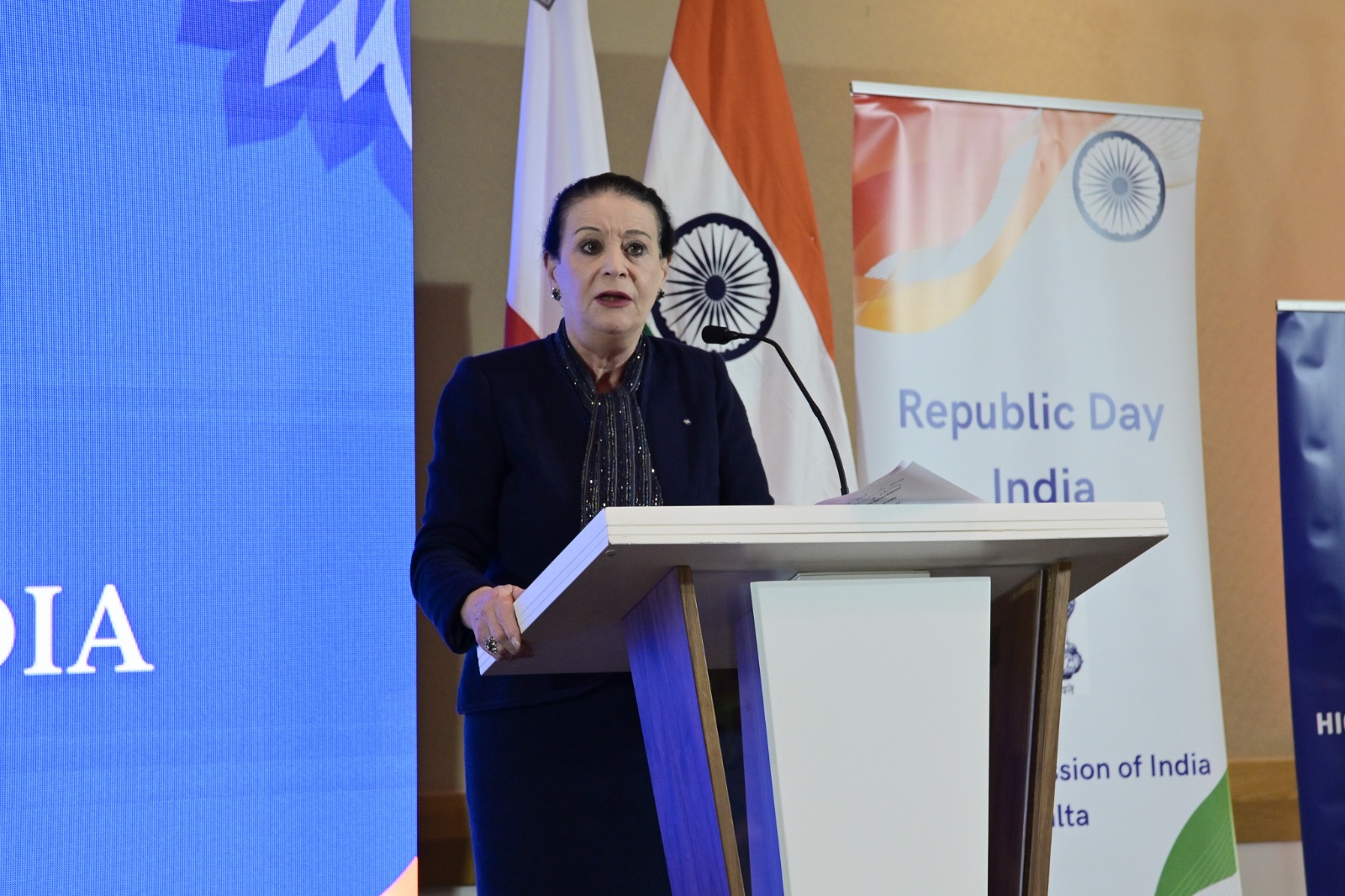
We are gathered here this evening to celebrate India’s National Day. Today’s event is also an opportunity to acknowledge the excellent bilateral ties that exist between our countries and to reaffirm the enduring friendship between our two nations.
Since the establishment of diplomatic relations in 1965, thirteen Agreements and Memoranda of Understanding have been signed between Malta and India. These range over an array of sectors, and include taxation, science, technology, culture, tourism, and education.
Commercial ties are strong, with sustainable trade and growing investment. I am also pleased to note that there are 114 Indian-owned businesses in Malta, an entrepreneurial presence that provides a solid foundation for sustaining and further expanding economic ties.
Over the years, our relationship has also been further enriched by high-level visits and meetings between the two sides. Such exchanges indicate clear political intent to intensify synergies in areas of mutual interest and the desire to bolster our partnership.
Looking ahead, we are committed to promoting diversified Indian investment and encourage Maltese companies to explore new opportunities in India. In this regard, enhancing air and maritime connectivity would tangibly support and facilitate closer trade and tourism flows.
In parallel, we remain committed to further strengthening cultural ties with India. The Indian High Commission in Malta and the Maltese High Commission in New Delhi are playing a critical role in this field through the organisation of cultural events.
Such initiatives are commendable, as they showcase what our respective countries have to offer in the fields of art, music, dance, literature, and poetry. In doing so, they are actively contributing to bringing our peoples closer together.
I salute the family-based commercial community, fully naturalised with its successive Malta-born generations which first settled in Malta at the beginning of the 1890s. Its members form part of the Maltese population, fully integrated into Maltese society by decades old commercial and personal relationships, including inter-marriages.
I salute and acknowledge as well the demographic stream of Indian nationals who are supplementing the local workforce in the medical, caring, and hospitality sectors. I express my sincere appreciation to them for their contributions to the social, economic, and cultural fabric of our country.
I also acknowledge the Maltese Missionaries who have worked in India since 1925, most notably among the Santal Tribe, having learnt the Santali language and contributed to their daily life for a whole century.
I also note the periodic review of bilateral relations taking place during the upcoming session of political exchanges, thereby seeking to consolidate current relations and identify new avenues of collaboration.
Ladies and gentlemen
The values that unite Malta and India are also seen in the international sphere, where our countries have invariably upheld their responsibility to actively contribute to the maintenance of international peace and security, and to serve as a voice for a more just and equitable world.
As we are all aware, the current uncertain geopolitical landscape demands our full attention and merits serious reflection. All countries have a duty to foster and uphold international peace and security, but this duty acquires added sharpness if one keeps in mind the declarations of the founding fathers of the UN in the aftermath of the devastation of World War II.
The responsibility to maintain order, security, and peace in the world during our times rests with all of us, and more so with those nations who hold bigger sway and are able to exert more influence. This influence should be exerted in ways which foster global harmony.
At a time of uncertainty, where conflicts continue to leave a catastrophic toll on civilians in different corners of the world, we must reaffirm our commitment to the principles enshrined in the Charter of the United Nations. We must strive to protect women and children, and other vulnerable groups, and leave no stone unturned to make sure that humanitarian aid reaches those in need.
As noted by the Secretary-General of the United Nations a few days ago, and I quote: ‘There is no shortage of urgent tasks before us. We are a world brimming with conflict, impunity, inequality, and unpredictability’ . Therefore, it is high time that as the international community of nations we synergise into collective and constructive action.
We need to strengthen the resolve to invest in the United Nations. We have to seriously start discussion for reform of this organisation, which has served as the backbone of our multilateral system for the past 80 years. This is not an easy discussion.
However, as I had occasion to remark before and in other forums, I repeat: those nations who actively believe in a just and peaceful world, cannot shirk this responsibility. The nations who believe in a rules-based international co-existence founded on mutual respect cannot afford to stand and wait while the UN becomes redundant.
We must stand united on the principles of international law, the territorial integrity of states, and national sovereignty in a clear and unequivocal manner. Our interactions must be guided by dialogue, respect, and understanding, not threats and coercion.
Equitable standards are also at the basis of fairness in trade and commercial relations between States. Adherence to the global rules of the trading system is also paramount to ensure predictable, transparent, and non-discriminatory trade between countries.
The decision taken by the European Union and India to implements these principles as part of the Free Trade Agreement is a clear reflection of this joint commitment. At a time when compromise appears to be in retreat, this historic moment is a manifestation of goodwill to reach common ground in the interest of the prosperity of our peoples – a goodwill which is sorely needed in international affairs at the moment.
As a member of the European Union, Malta will also continue to advocate for stronger and deeper relations between India and the European Union. The Strategic Partnership between India and the EU can help enhance cooperation across key sectors including business, climate action, digital innovation, and maritime security, while the EU-India Strategic Dialogue can promote and contribute towards stability in the Indo-Pacific region. These themes have indeed been at the core of last Tuesday’s EU-India Summit in New Delhi, underscoring deeper geo-political alignment and future-oriented cooperation.
The Commonwealth, on its part, provides Malta and India with another forum for cooperation on important issues, particularly upholding democratic values, human rights, and the rule of law.
It is essential that we leverage all the tools and spaces at our disposal to their fullest potential, so that our actions contribute to a better world for our citizens and future generations.
Ladies and gentlemen
I once again extend my thanks to Ms Rajan for hosting us this evening. Malta looks ahead with optimism to continue strengthening the bonds between our countries.
On behalf of the people of Malta, I raise a toast to the health of Her Excellency Droupadi Murmu, President of India, to the enduring friendship between our peoples, and to a bright future ahead.
Any reproduction of this speech requires prior permission by the Office of the President of Malta. Kindly contact the Public Relations Office on [email protected] and [email protected].