


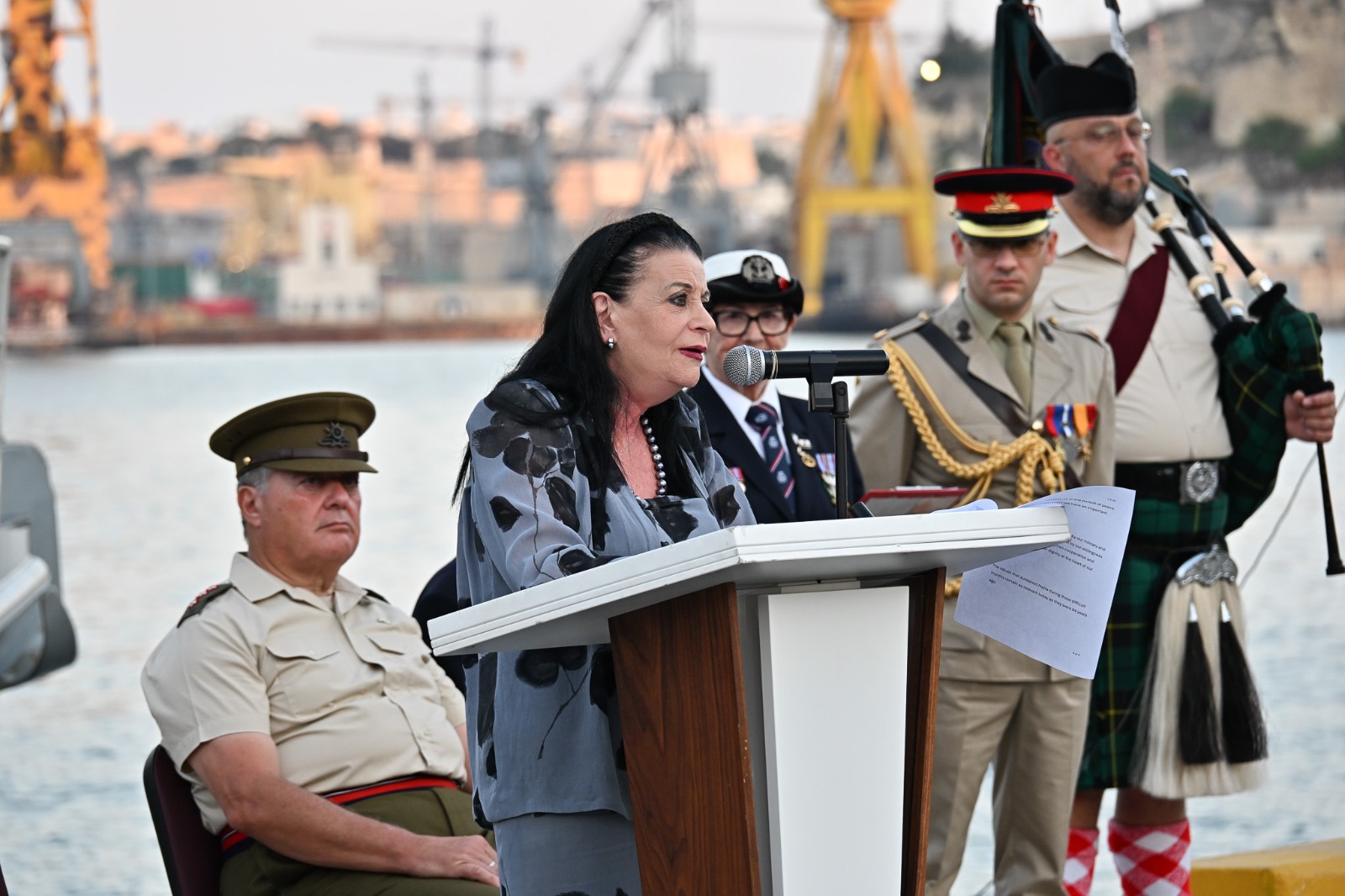
This year is the 84th anniversary of Operation Pedestal.
It would be pointless to gather here, year after year to remember the courage and sacrifice of previous generations if we fail to draw from their experience the lessons that remain relevant to this day.
The aftermath of the two world wars brought with it the realisation that lives would have been lost in vain, if a future, forged on the principles of peace, freedom, harmony between nations and above all the dignity of humankind, is not sustained and sustainable.
The present-day global conflicts, especially those nearer to us, the ongoing conflict between Russia and Ukraine, the situation in the Middle East as well as other hot spots around the world, if anything, only accentuate the truth behind the saying that war has no victors, only losers. This is not a cliché; experience has strongly taught us it is a sacrosanct truth; it strongly manifests the fact that cessation of armed conflict does not equate with peace.
Once the bombing stops, a new war commences – involving infrastructural reconstruction and stability measures. To this must be added the dismemberment of hatred, instilled by centuries old prejudices, and in certain instances even unfortunate decisions which did not result in the desired beneficial effect. Situations which only make it more difficult to restore security and harmony in the lives of populations.
Security cannot be simply interpreted in military terms. People should never live in fear, uncertainty and deprivation, with seeds of future divisions and flareups still curdling in their hearts and minds in spite of so-called peace treaties/agreements.
I believe that a reference here to the debate surrounding the Strait of Hormuz and the war between Iran and the United States of America is in order.
The Strait of Hormuz may not be part of the “common heritage of mankind” in the strict legal sense, as it lies within the national boundaries, in the territorial waters of Iran and Oman. However, it is still governed by the United Nations Convention on the Law of the Sea (UNCLOS) by its regime of transit passage which recognises the right of freedom of passage in the facilitation of international navigation.
Freedom of passage through the Strait of Hormuz is essential for the smooth functioning of global economy.
Through it pass daily circa 20% of globally traded energy fuels, and therefore any closure or hindrance to freedom of passage would adversely affect global energy supplies, registering an increase in the prices of oil, liquid gas and other fuels.
Its ripple effect would be disastrous, transport shipping and manufacturing costs are increased, resulting in higher prices for food, increased inflation, slower economic growth adversely hitting the standard of living of individuals.
This holistic scenario underlines a profound responsibility; greater political clout carries with it a greater responsibility; a responsibility that should erode any notions of domination and imposition in a world of interdependence.
Might is not the mother of Right – it is imperative that countries with more influence than others on the international stage take leadership roles in all spheres, moving forward the agenda of present-day challenges facing the world’s citizens, in certain instances threatening the globe’s very existence.
As heatwaves sweep across the European continent this is one challenge which should merit concerted efforts.
This broader concept of peace is firmly rooted in various declarations, and when not expressed, or clearly enunciated; it can be gleaned from between the lines.
Once the destruction by armaments ceases, its effects are not simply switched off or obliterated – the pain of wounds and the burdens of regeneration are carried forward through generations.
Ladies and Gentlemen,
Malta’s Constitution commits us to the pursuit of peace and international cooperation; we have an important role to play.
Malta’s role nowadays is not defined by our military and geographic strategic positioning, but by our willingness to encourage dialogue, strengthen cooperation and placing respect for human dignity at the heart of our actions.
The values that sustained Malta during those difficult months remain as relevant today as they were 84 years ago.
The sacrifices of our forefathers call on us not to turn away from human suffering, but to stand up for the principles that promote lasting peace, and to continue building a society where differences are resolved through dialogue rather than violence.
May the memory of those who gave so much during Operation Pedestal remind us that peace is never certain. Every generation must protect, care for, and strengthen it.