


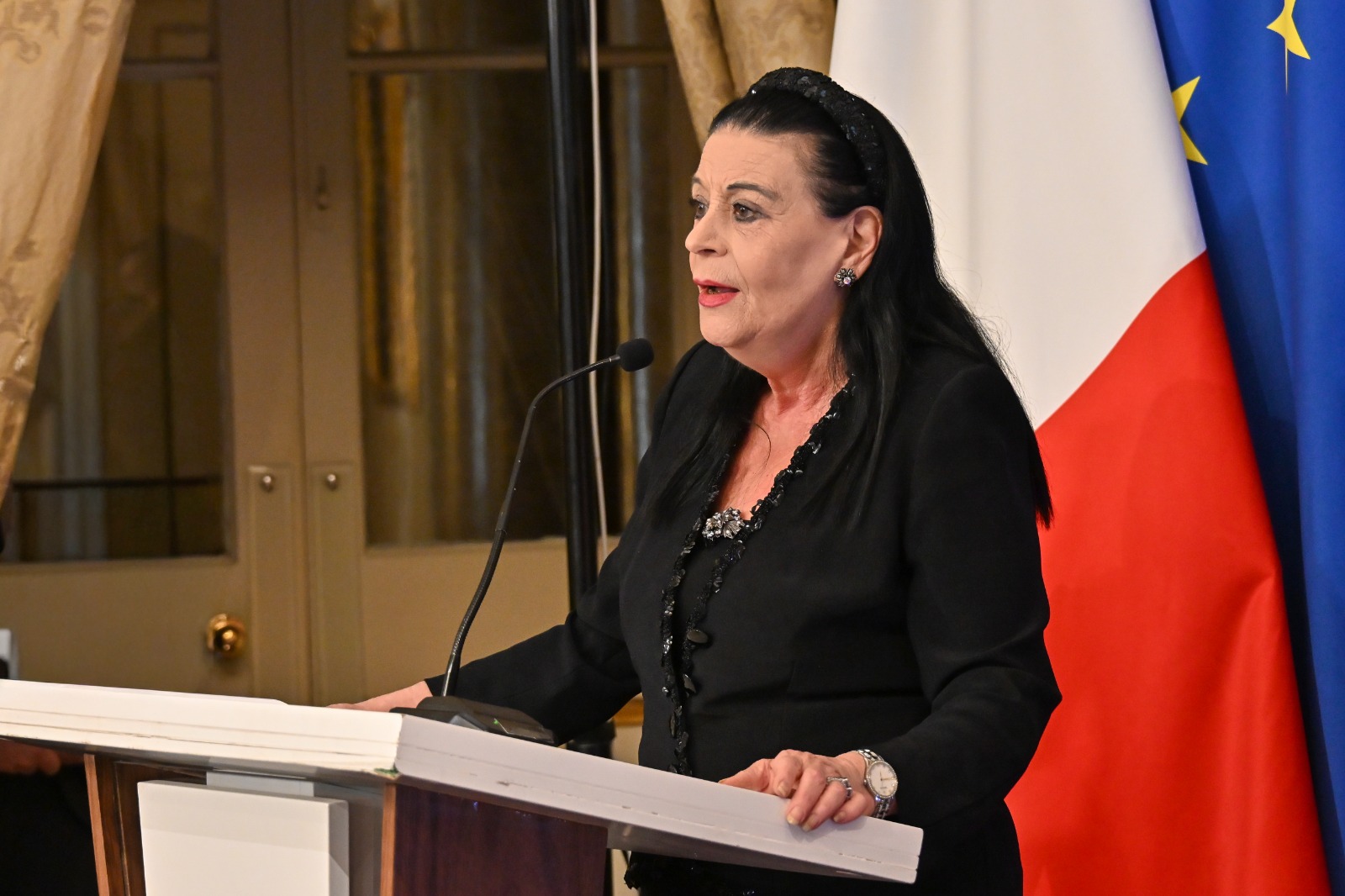
It is with great pleasure that I welcome you all to San Anton Palace the private residence of the President of Malta.
Under my tutelage, San Anton Palace, has opened its doors to wide sections of the population.
This has made it possible for old and very young alike, to further savour the inheritance bequeathed to Malta and its people by the Sovereign Military Hospitaller Order of St John of Jerusalem, Rhodes and Malta, commonly referred to as the Sovereign Military Order of Malta.
We meet here today in the Grandmasters’ Hall, as I remember it was commonly referred to up to about twenty years ago, to witness the launching of a publication entitled “Sixty Years of Service – The Maltese Association of the Order of Malta 1965 – 2025”.
When the author Ambassador Noel Buttigieg Scicluna, first approached the Office of the President to coordinate this evening’s launching event, in his own words, he referred to his opus as “a work about the chronicles of the Maltese Association over the last sixty years” – however, today’s publication does much more than recount chronological events.
I found the events therein referred to, particularly interesting, unique even, in the undertones colouring the chronology of events, undertones which found their way into the narrative as a consequence of Malta’s social and political evolution ——- So to say, references, which, although at times oblique, can be traced to Malta’s political vicissitudes, culminating in Malta’s sovereign status and the road to the commencement of diplomatic relations between the two sovereign entities of Malta and the Order in 1966.
It is interesting to experience the background leading to this.
I was particularly intrigued by the reference in Chapter 5 to a report dated 10ta’ September 1965 – 400 years after the Great Siege, that for then Vice Chancellor of the Order, Fra Enrico Montalto de Fragnito, the century and a half of Great Britain’s domination could be brushed away, and the situation revert back to the Treaty of Amiens of 1802, and particularly Article 10 thereof which stated at its very beginning, that “The islands of Malta, Gozo, and Comino, shall be restored to the Order of St John of Jerusalem, to be held on the same conditions on which they possessed them before the wars”. The article stipulated other conditions, of particular significance, from many angles, but I shall be singling out one instance with regard to the Maltese Association of the Order of Malta later on.
At this juncture, one has to refer to the Bill of Rights of the Maltese, 15th June 1802, asking for internal self-government by the Maltese for the Maltese, but under the protection of the King of Great Britain, that is, directly under the Crown.
The Maltese Declaration of Rights was sidelined by the Treaty of Paris of the 30th of May 1814, since Article VII stated that “The island of Malta and its dependencies shall belong in full right and Sovereignty to His Britannic Majesty”, in no way incorporating any of the clauses in the Bill of Rights of the Maltese, and thus, effectively, historically and politically, giving rise to Colonial domination, which lasted till the advent of Independence.
During this period, one can say that due to the tangible presence of the Order by virtue of Valletta itself and other influences, the cultured classes of Malta throughout all those years nurtured a deep appreciation of the benefits Malta derived from the Orders’ presence in our islands.
This manifested itself in the dedication and energy, that went into the organisation of the important Pauline centenary celebrations of 1960, the 1962, Commemoration of Mattia Preti’s coming to Malta, and above all, the 400th Anniversary of the Great Siege 1565-1965.
The proclamation by Grand Master Fra Angelo de Mojana on 2nd September 1965, of the Maltese Association of the Order of Malta, at last established what may be considered as the successor of the Maltese langue postulated by Article X of the Treaty of Amiens.
However, for a considerable period of time from 1965, the Association in its modus operandi, was to some extent, shackled by matters necessitating diplomatic agreements with the government of Malta regarding recognition, and the admission of new members when the Association itself was diminishing in members by virtue of the passing away of older members. I am here referring to the freezing of new investitures, recounted in Chapter Twelve.
During this period, one cannot but admire the tact and wisdom of successive Grand Masters not to embark on a collision course with the Maltese governments.
The order’s pretensions to the Maltese islands were finally put to rest when agreement was reached in December 1987, which agreement, amongst other clauses, stipulated that Maltese citizens members of the Order could not, at any time, hold the dual citizenship of the Order and of Malta.
However, one has to remark that the travails of the Association during the first 22 years of existence were intertwined with the social, political and constitutional commotions, nay upheavals taking place in Maltese society.
The climate was not helped, so to say, by the strong personalities of the protagonists pervading that period, as well as the undercurrents of mistrust permeating the national atmosphere.
To mention, particularly, the relations between the Church and the Labour party, is an understatement.
Those of us who remember those years surely understand what I am saying – especially those who like me had the very good fortune to personally know and experience two of the foremost protagonists. Monsignor Coleiro was one of my professors during my first three years as a University student. His manner was brusque, at times he could be abrasive, while of course, as far as Prime Minister Mintoff is concerned, he is far from being generally renowned for finesse.
The greater part of the rest of the book is devoted to the cordial collaborative relations between Malta and the Order, relations now also helped along by the clear delineation of boundaries between the role of the diplomatic representative, the Ambassador of the Order to Malta, the government of Malta, and the Malta Association of the Sovereign Military Order of Malta.
Various chapters of Ambassador Buttigieg Scicluna’s book, deal with the philanthropic work of the Maltese Association, and I am sure that the President of the Association, Dr Michael Grech, can give a better overview of that.
But I feel that I would not only be ungrateful, but also unjust if I do not at least mention one instance of the Association’s contribution to the wellbeing of the Maltese society: and in this regard, I have to single out the Blood bank for special mention.
The Blood Bank, established on the 15th of June 1968, was the forerunner of the present-day National Blood Transfusion Service, and the foundations for the conscientious social awareness which the National Blood Transfusion Service strives to nurture and foster each and every single day.
The SMOM Blood Bank tangibly manifested the importance of the contribution by the individual components of society itself, by persons, in the healing process.
I would like to conclude by repeating the words of Dame Victoire Borg Manche with regards to the COVID-19 pandemic as quoted at the end of Chapter 13 of Noel’s book “We have put normality back into people’s lives. We share precious moments as we have become one large family. Every smile on their face is a reward ”.
Article 2 (1) of the Constitutional Charter of the Order states that “The purpose of the Order is the promotion of the glory of God through the sanctification of its members” and what better way to reach sanctity and alleviating people’s suffering and burdens, effectively bringing smiles to peoples’ faces?
In conclusion, I believe that this is a book which should grace the bookshelves of all who hold dear Malta’s culture, history, social and political evolvement, and I sincerely think it should have a place in all school libraries.