


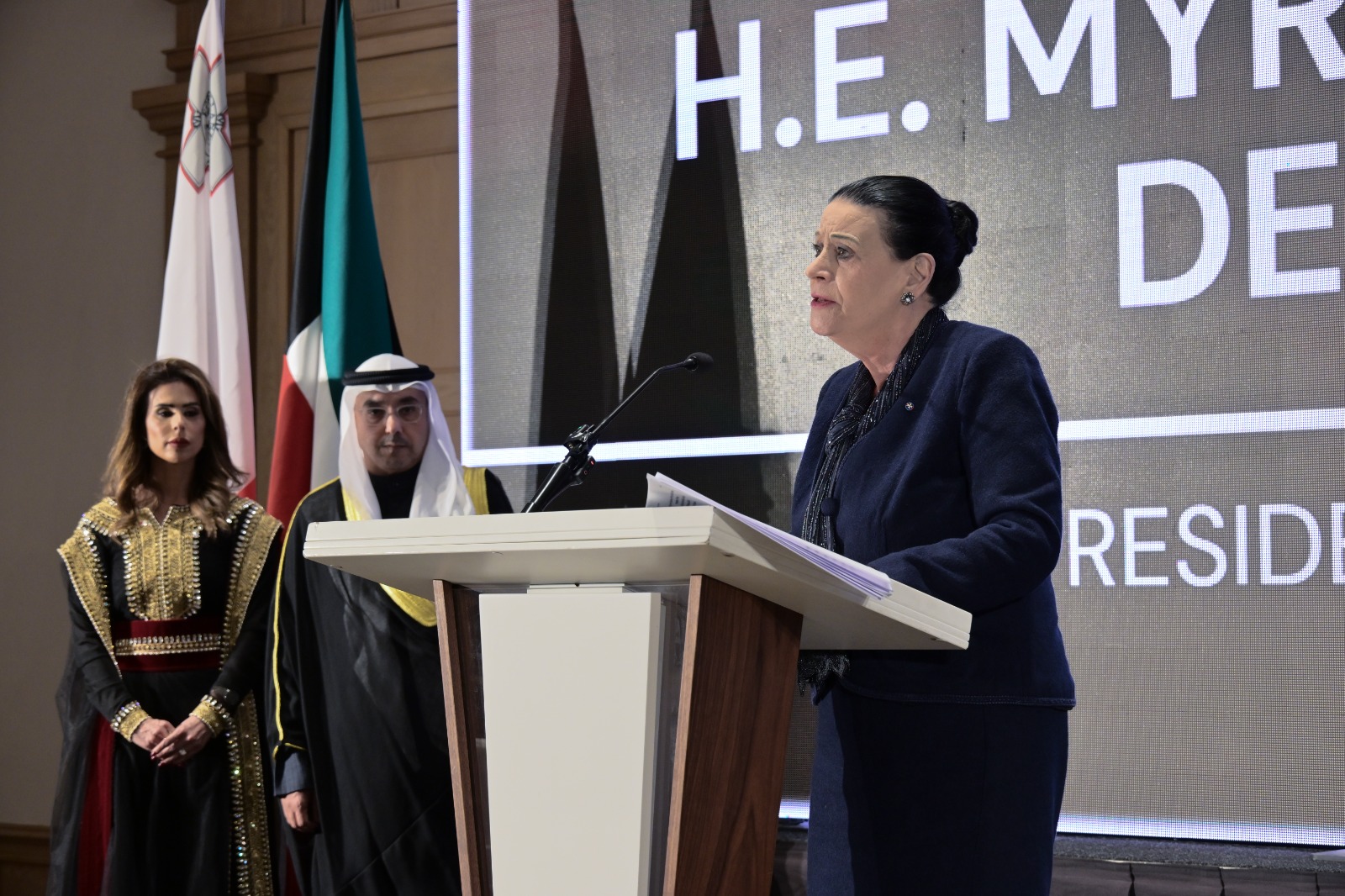
It is a pleasure to join you in celebrating Kuwait’s National Day and reaffirm the enduring friendship between our two countries.
Since the establishment of diplomatic ties in 1972, Malta and Kuwait have enjoyed excellent relations based on respect and shared ideals. This affinity has been reflected in bilateral agreements and high-level visits, further strengthening our bond.
Trade between our countries spans a broad range of sectors and services, and has increased considerably over the past five years. The fields of education, culture, energy, environmental management, financial services, and cybersecurity present valuable opportunities for us to further deepen and expand commercial ties.
In this connection, I recall the Malta-Kuwait Joint Commission for Bilateral Cooperation held in May 2021, which resulted in several agreements covering areas such as trade, investment, education, health, security, and youth.
Malta will continue to encourage all measures aimed at promoting business ties, and we welcome initiatives that seek to bring about increased interaction between our respective commercial stakeholders. We are keen to continue building on these achievements in a pragmatic and adaptable way that is aligned with our respective visions and long-term priorities.
To this end, in December last year Malta launched the Gulf Regional Framework Policy, which sets out Malta’s strategic approach to engagement with the Gulf. This Framework focuses on five key areas, namely: (i) regional and bilateral relations; (ii) commercial relations; (iii) social affairs; (iv) multilateral affairs; and (v) climate and energy.
Moreover, reflecting our firm belief that the Gulf is a dynamic centre of economic growth, cultural richness, and geopolitical significance, Malta has appointed a Government Envoy to the region.
Cooperation in the cultural field is also noteworthy. In December 2025, the exhibition ‘Memorja’ was launched by the Maltese Embassy in Kuwait in collaboration with the Malta National Archives and the Kuwait College for Science and Technology, and with the support of the Cultural Diplomacy Fund. This exhibition focused on oral history in Malta and Semitic countries, exploring themes such as language, sea, salt, and folk music. Such initiatives play an important role in bringing our nations closer to each other, and in enhancing people-to-people contacts.
In this context, I recall a number of Memoranda of Understanding that the University of Malta as well as the Malta College for Arts, Science and Technology (MCAST) have signed with the Kuwait University and other respectable private universities, aiming to further academic collaboration and student exchanges.
Kuwait is also a highly valued partner of the European Union, particularly in view of our shared efforts to promote security and prosperity in our common neighbourhood. As an EU member, Malta will continue to advocate for stronger relations between Kuwait and the European Union, as well as for deeper engagement with the Gulf Cooperation Council.
On this note, we welcome the positive momentum generated since the first EU-GCC Leaders’ Summit held in October 2024. We look forward to the next Summit this October, which will provide an ideal setting for substantive discussions on strengthening cooperation on regional security, counterterrorism, and crisis management, which is even more important in the current regional context.
Ladies and gentlemen
As two small states, Malta and Kuwait are also steadfast supporters of the multilateral system. The current international situation merits our full attention, and the trend which has seen international law and multilateralism increasingly circumvented is not sustainable.
Malta and Kuwait both fully understand the dangers of an international landscape where threats and coercion replace trust and dialogue. An international scenario where stronger nations are guided solely by their self-interest can only result in discord, destroying equity in interstate relations and negating any lasting foundation for peace.
Regrettably, as the UN Secretary-General noted just a few days ago, and I quote: ‘There is no shortage of urgent tasks before us. We are a world brimming with conflict, impunity, inequality, and unpredictability’ .
Yet, as conflicts continue to plague different regions around the world, the multilateral system that has been in place for the past 80 years is paradoxically being side-lined.
While we must never give up the quest for avenues which can contribute and lead to peace, it is important that we keep the UN at the core of all efforts by international and regional organisations. It is imperative that the commitments undertaken by the community of nations in San Francisco in the aftermath of World War II continue to guide interactions among nations.
The principles enshrined in the Charter of the United Nations – the principles of peace, human rights, the worth of all persons, equality among nations, and the promotion of social progress – must be safeguarded and respected. They are universal and transcend generations, and we must spare no effort to make sure that they are preserved and reinforced, and not derogated from.
We cannot afford to move away from dialogue and cooperation. This is especially true in a world that is facing challenges that go beyond national borders, challenges which are not transgressions of international law, nor are these challenges emanating from war and armed conflict. Climate change, transnational crime, irregular migration, and cybercrime hit directly at individuals, affecting their life at basic levels, a menace to their wellbeing, physical safety, day-to-day security diminishing harmonious living.
Normalising confrontation and coercion in place of genuine and inclusive engagement simply undermines our collective ability to address these issues in an efficient and effective manner.
Furthermore, it is more critical than ever that all countries, regardless of size and wealth, are included in discussions, especially those impacting them directly. It is imperative that their views and concerns are given due consideration.
As two countries that believe in the importance of peaceful solutions to international disputes, Kuwait and Malta have never shirked their responsibility to contribute towards peace and wellbeing. This manifests itself in the manner in which both countries conduct themselves in international affairs.
Both countries served as elected members of the United Nations Security Council in the last decade, leaving a lasting mark by penning important resolutions and bringing pressing matters to the table when the situation warranted such action.
Both were principled and consistent in highlighting the importance of international humanitarian law and the need to ensure that humanitarian aid reaches those in need.
I hope that in the years to come our countries will continue to serve as reliable members of the international community.
Ladies and gentlemen
I once again extend my thanks to Ambassador Al Mudhaf for hosting us this evening. Malta looks ahead with optimism to continue strengthening the bonds between our countries.
On behalf of the people of Malta, I raise a toast to the continued well-being of His Highness Sheikh Meshal Al-Ahmad Al-Jaber Al-Sabah, Amir of the State of Kuwait, and to the enduring friendship between our nations and our peoples.
Any reproduction of this speech requires prior permission by the Office of the President of Malta. Kindly contact the Public Relations Office on [email protected] and [email protected].