


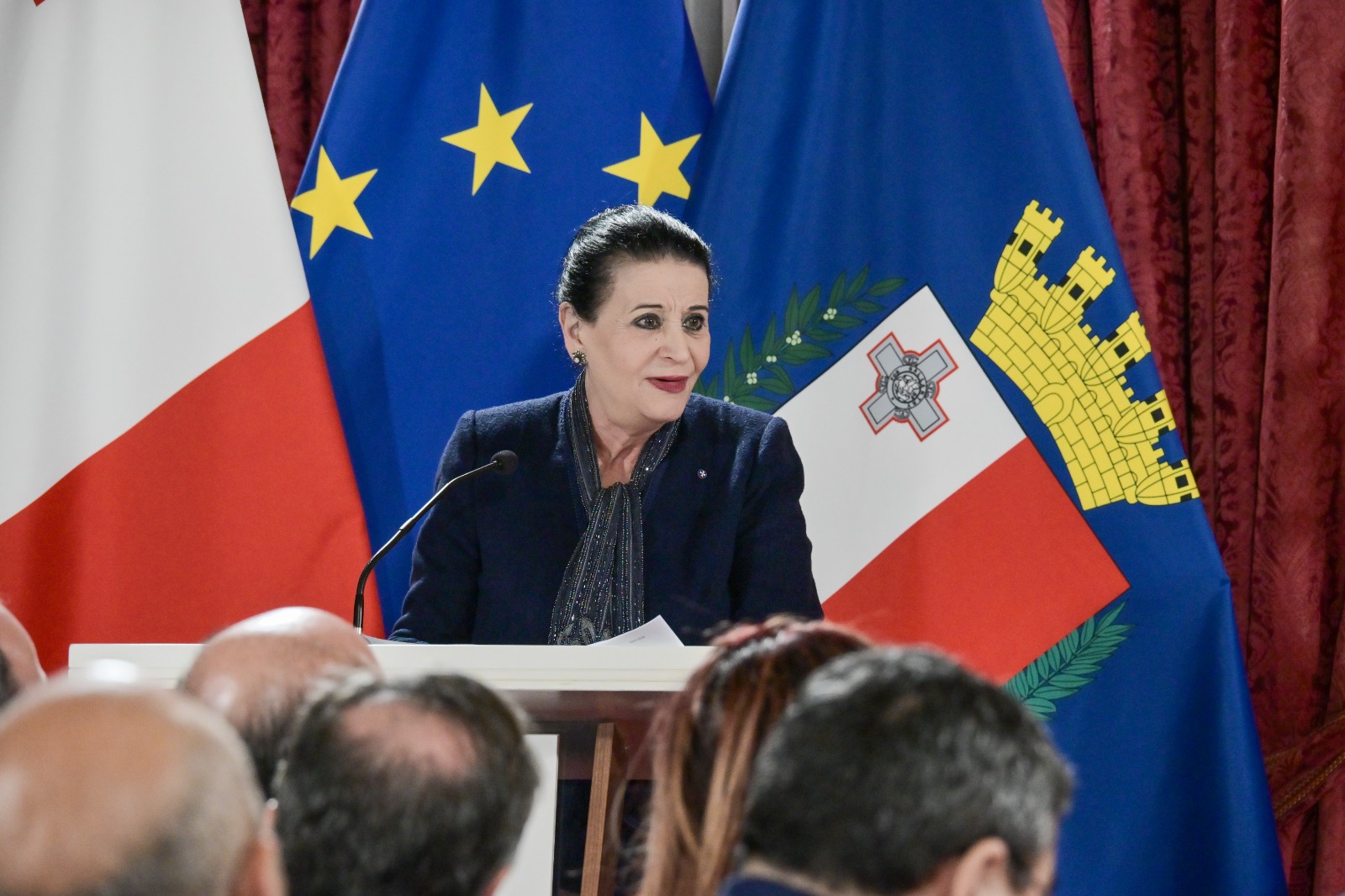
I welcome you all to the beginning of the new year 2026, not only as the accredited Ambassadors of your countries to Malta, but also as friends of our country.
I commend each and every one of you for the work you have carried out in the past 12 months. Your efforts aimed at strengthening the bilateral ties, enhancing trade, and increasing people-to-people contacts between Malta and your respective countries are truly appreciated.
Since achieving Independence in 1964, Malta has consistently acted as an honest and reliable partner. As I noted on Republic Day, we are a young nation. Nevertheless, consistent efforts by successive administrations, backed by a skilled and capable workforce, have contributed to building a vibrant, diverse, and resilient economy. Over the years, this economic policy has transformed our island into a hub for trade, financial services, tourism, advanced manufacturing, pharmaceuticals, and information technology. Today, Malta’s economy ranks ninth in the European Union in terms of GDP per capita; this is quite an achievement.
In the new year, we will continue to work hard to enhance and bolster existing ties for the mutual benefit of our countries and our citizens. We are keen to engage in meaningful dialogue with all countries to explore new avenues of cooperation in different sectors.
This openness was amply reflected over the past year, in which several high-level visits provided an opportunity for political consultations and the signing of bilateral agreements.
During this period, Malta has also launched initiatives aimed at facilitating such growth. The Gulf Regional Framework Policy, launched in December, sets out Malta’s strategic approach to engagement with a region that is not only a hub for global energy resources but also a dynamic centre of economic growth, cultural richness, and geopolitical significance.
Apart from the bilateral aspect of our foreign policy, in 2025 Malta also continued championing multilateralism by actively contributing on the international stage.
Malta was elected to the Executive Committee of the Bureau d’Expositions; the Standing Committee of the Regional Committee for Europe of the World Health Organization; the Bureau of Committee of Experts on Sexual Orientation, Gender Identity and Expression, and Sex Characteristics (ADI-SOGIESC); and, most recently, to Category C of the Council of the International Maritime Organization. I express my sincere appreciation to all member states for their support in these elections.
Between May and November 2025, our country held the Presidency of the Committee of Ministers of the Council of Europe, prioritising youth engagement in democratic life; the protection of children and the best interests of the child; and combating violence and discrimination while promoting equality and human rights.
To this end, during our Presidency, I undertook two visits to Strasbourg, during which I addressed both the Parliamentary Assembly of the Council of Europe and the European Court of Human Rights. Through these engagements, I wanted to reaffirm Malta’s steady commitment to these priorities and stress that rights achieved are not rights automatically guaranteed.
Additionally, in March 2025, Malta hosted the International Conference on National and Regional Counter‑Terrorism Strategies, which gathered representatives from over 50 countries, UN entities, NGOs, and the private sector, and which concluded with the adoption of the Valletta Principles.
In December, Malta launched its second Women, Peace and Security National Action Plan, another milestone in our ongoing efforts to mainstream gender perspectives in peace and security and embedding United Nations Security Council Resolution 1325 and its subsequent resolutions into our national frameworks and diplomatic systems.
In the coming months, Malta will also be launching a dedicated framework to further structure its engagement with African partners, in response to evolving regional and global realities. We remain committed to continue to engage with our African partners on the basis of partnership and support for African-led approaches to peace, stability, and development.
Similarly, we recognise the increasing importance of Asia and Oceania in an ever connected and globalised world. With this in mind, Malta is also preparing a focused framework that will bring to the fore this region’s rich contribution to our diplomatic, economic, and cultural growth.
Excellencies, distinguished guests
On this occasion, allow me to share a few reflections on the international landscape. In a global context marred by conflicts, geopolitical tensions, disregard for human rights, and challenges to international law, your job as diplomats is more indispensable than ever before.
The Mediterranean basin, our immediate neighbourhood, continues to face complex and multifaceted challenges which continue to amplify fragility and act as obstacles to peace and sustainable development. In the Middle East, the cost of prolonged conflict remains stark.
We continue to believe that the Two-State Solution remains essential for achieving lasting peace and stability in the region hopefully resulting in a framework where both Israel and Palestine can coexist in peace, dignity, security, and mutual recognition, paving the way for prosperity and dialogue.
The Mediterranean remains central to our foreign policy, firm in our belief that the pursuit of peace and stability in the region cannot be put on the backburner. We must also include women and young persons as agents of change that can transform the region and help it thrive.
Russia’s illegal and unprovoked aggression against Ukraine is entering its fourth year. Here too, genuine efforts towards peace are urgently needed to reach a peaceful settlement that respects Ukraine’s independence, sovereignty, and territorial integrity within its internationally recognised borders.
Beyond our region, recent developments in Venezuela have also highlighted the fragility of international law. This crisis has also served as a reminder of the responsibility of all states and leaders to safeguard the human rights of their citizens, and to ensure that electoral outcomes are respected through peaceful, democratic transitions. At this juncture, calm and restraint are called for by all actors so that reactions do not exacerbate the plight of the Venezuelan people, but rather Venezuelans are assisted in securing the democratic environment they deserve to live in and lead.
Also, the international community cannot lose sight of other conflicts across Africa, the Middle East, and beyond, particularly Sudan, Syria, Yemen, DRC, Afghanistan, Haiti, and Myanmar.
Apart from conventional wars, new global challenges are demanding our collective attention. Climate change, an existential threat that does not recognise national borders, is a prime example. It fuels sea-level rise, desertification, water scarcity, and food insecurity, acting as a threat multiplier in conflict situations. In this regard, Malta will continue highlighting the disproportionate way in which climate change is impacting Small Island and Developing States and contribute to their sustainable development.
Likewise, irregular migration also requires concerted efforts to make sure that countries of origin, transit, and destination are not left to contend with this issue in isolation. Multilateral processes must be maintained to promote safe, orderly, and regular migration, while always keeping the humanity of migrants at the centre of our considerations.
As technology continues to advance, cyber activities present challenges with profound security implications. Misinformation and disinformation are intensifying conflicts by increasing polarisation and undermining the integrity of public information.
The advent of artificial intelligence requires robust governance frameworks to ensure that it remains secure, trustworthy, and human-centred.
All these realities underscore the need to invest in diplomacy and dialogue, and in the institutions that facilitate the peaceful settlement of disputes. A world in which might is right would be detrimental to all countries, especially small nations.
As noted by the Deputy Prime Minister and Minister for Foreign Affairs and Tourism Ian Borg in the Foreign Policy statement for 2025-26, the only constant we are facing is change. In an ever-changing geopolitical landscape, we have to hone the ability to adapt if newly arising situations are to be addressed in a timely and effective manner.
At the same time, our adherence to the principles enshrined in the Charter of the United Nations has to be strongly reaffirmed, renewed faith in the shared values that unite us has to bond us more strongly together, and above all, we have to sustain the effectiveness of the multilateral system.
As a committed multilateralist, Malta will continue to advocate for these principles in 2026.
The different threats to the erosion of democratic values which are constantly emerging call for focused attention. In fact, over and above the vigilance needed to safeguard what has been achieved so far, we must continuously try to foster the evolution of democratic practices and thoughts to give concreteness to the underlying basic principles of the sovereignty of the population founded on the principles underlying the rule of law within national borders. Over and above this, the rules of international law are our most important tools to guard against the dangers of hegemony.
In an evolving international scenario, it is absolutely necessary that newly rediscovered hegemonic tendencies are kept at bay. The upholding of the principles of the UN Charter cannot be overemphasised, and it is incumbent on all peace-loving nations to utilise to the hilt the opportunities in fostering international trust and harmony provided by multilateral forums.
History has shown us that when humanity, inclusion, and understanding serve as our guiding light, peace and prosperity find fertile ground to flourish.
I am confident that, together, we can navigate the challenges ahead.
I thank you, and once again wish you all the best for 2026.
Any reproduction of this speech requires prior permission by the Office of the President of Malta. Kindly contact the Public Relations Office on [email protected] and [email protected].